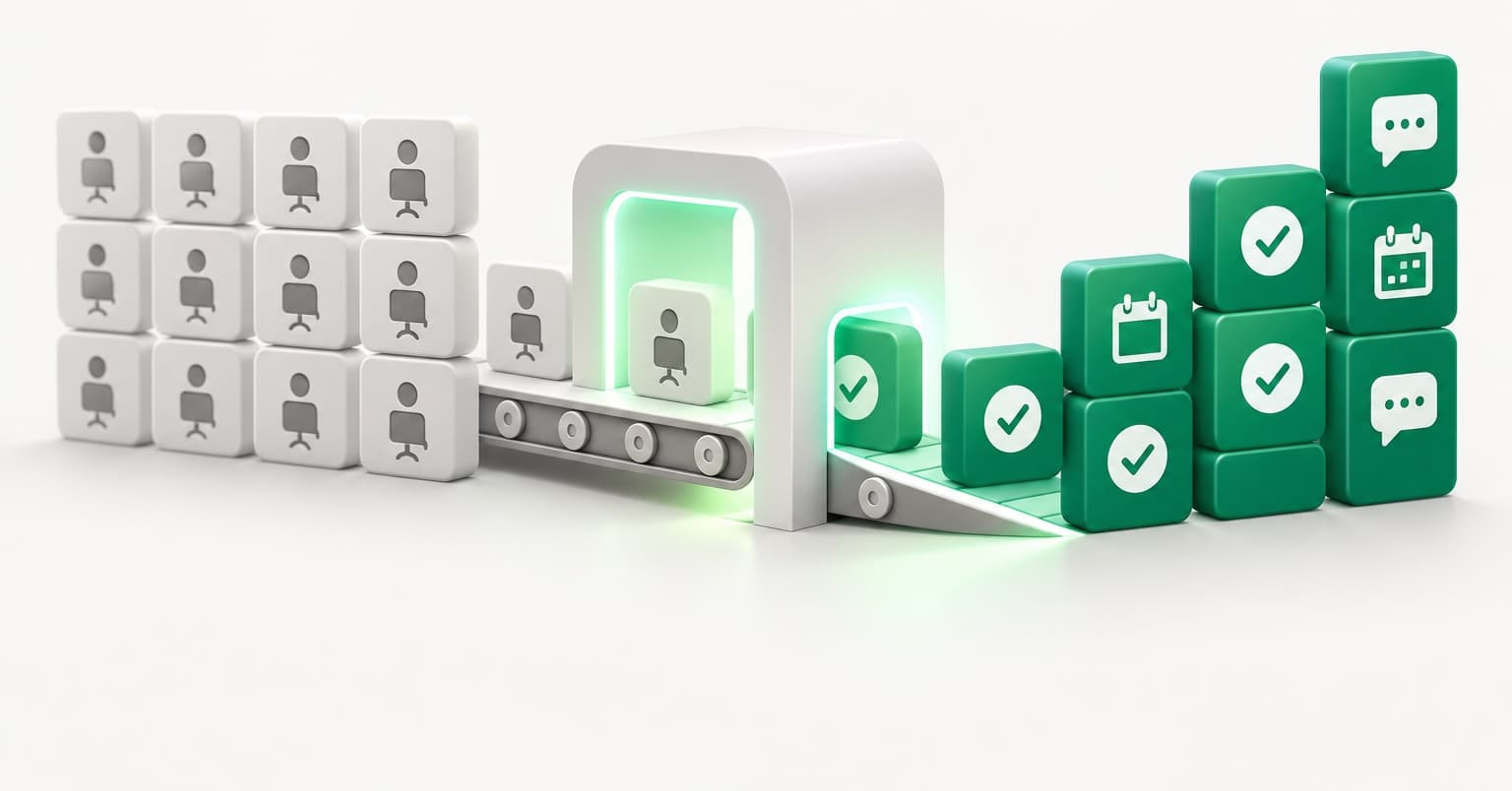
From SaaS to RaaS: Why Software Is Moving to Results as a Service
Results as a Service (RaaS) means paying for finished outcomes, like resolved tickets or booked appointments, instead of seats. Intercom, Zendesk and Sierra already bill this way. Here is what is changing, where outcome pricing breaks, and what it means for small businesses buying AI.
Results as a Service (RaaS) is a way of buying software where you pay for a finished, verified outcome, like a resolved support ticket or a booked appointment, instead of paying for seats or logins. You'll also hear it called outcome-based pricing or "service-as-software." AI agents are what made it possible: software can now do the work, not just help a person do it.
I build AI systems for small businesses, and this year I watched the idea move from investor decks onto actual price lists. Intercom charges $0.99 per outcome for its Fin AI agent. Zendesk charges $1.50 per automated resolution. Gartner thinks up to $234 billion of enterprise software spend is exposed to AI agents by 2030.
So what's changing, who already bills this way, and where does it fall apart? And if you run a clinic, a med spa or any service business, should you care? (Short version: yes, but probably not for the reason vendors want you to.)
Key takeaways
- SaaS sells access to a tool your team operates. RaaS sells the finished work, and the vendor gets paid when it's done.
- Outcome pricing is already public. Intercom Fin is $0.99 per outcome, Zendesk is $1.50 per automated resolution, and Sierra says it's only paid when a task gets completed.
- Per-seat pricing is under real pressure. Gartner says agentic AI "breaks the link between user growth and revenue growth" for vendors that charge by the seat.
- Pure RaaS is still rare. Most vendors are settling on a hybrid of platform fee plus per-result or per-action charges. Salesforce went through three Agentforce pricing models in roughly a year.
- The per-unit price matters less than the definition. Who decides a ticket was resolved, and what happens on a handoff, is where the money actually moves.
- For a small business, RaaS is most useful as a way to judge AI, even if you're paying a flat monthly fee. Track cost per booked appointment, not cost per month.
What is Results as a Service (RaaS)?
Results as a Service is a pricing and delivery model where the vendor is paid for a business outcome its software produces. You're billed per result: a resolved conversation, a qualified lead, a saved cancellation, a reconciled invoice. Access to the software itself is either bundled in or a smaller line item.
Different vendors use different names for it. Zendesk and Sierra say outcome-based pricing. Intercom and Zendesk list prices per outcome or per resolution. Foundation Capital calls the wider market shift service-as-software.
A quick naming note, since search engines mix these up: in security, RaaS means Ransomware-as-a-Service, and in hardware it can mean Robotics-as-a-Service. Here it always means Results as a Service.
SaaS vs RaaS: what actually changes
The bigger change is who's on the hook for the work getting done. The invoice just follows from that.
| SaaS (Software as a Service) | RaaS (Results as a Service) | |
|---|---|---|
| What you pay for | Seats, logins, feature tiers | Resolutions, bookings, completed tasks |
| Who does the work | Your staff, using the tool | The vendor's AI agent, with people handling exceptions |
| Who owns the result | You | Shared. The vendor doesn't get paid unless it happens |
| Pricing unit | Per user per month | Per verified outcome, often plus a platform fee |
| Vendor incentive | Sell more seats, keep you from churning | Get more outcomes done, raise the success rate |
| Your risk | Paying for licences nobody logs into | A bill that grows with volume, and arguments over what counts |
| What you manage | Adoption and training | Outcome definitions, quality checks, escalation rules |
The way I usually put it: with SaaS you buy a better shovel. With RaaS you pay someone for the hole.
Why is software moving from SaaS to RaaS now?
AI agents can finish the job
For about twenty years, business software was something a person drove. Your CRM never followed up with a lead. A salesperson did, using the CRM. Charging per seat made sense because the value grew with the number of people logged in.
Agents don't fit that model. A voice agent answers the phone, works out what the caller needs and puts the appointment on the calendar. A support agent reads the ticket, checks the order and issues the refund. Once software does the whole job, charging for the job is the obvious next step.
Seat pricing punishes the vendor for doing well
Say an AI agent takes 60% of your support volume. You now need fewer support staff, so a vendor charging per seat makes less money precisely because its product worked. That's a strange incentive to build a business on.
Gartner put a number on it in July 2026. It estimates that up to $234 billion of enterprise application spending is exposed to "agentic arbitrage" by 2030, roughly 20% of enterprise application SaaS spend. Agentic arbitrage is Gartner's term for agents completing tasks across several systems so people stop logging into each one. Gartner's George Brocklehurst said these systems "break the link between user growth and revenue growth" for many enterprise software vendors (Gartner).
The real budget is services, not software
Foundation Capital's service-as-software thesis sizes the opportunity at about $4.6 trillion. Roughly half is salaries for roles like sales, engineering, security and HR, and the other half is spending on IT and business process outsourcing. That's several times bigger than the enterprise software market. The bet is that AI companies will compete for the services budget by taking responsibility for outcomes. Their line: "An outcome-based approach aligns the software's cost with the value it actually brings to a business" (Foundation Capital).
The stock market noticed
In late January and early February 2026, software stocks dropped hard after Anthropic added sector-specific plugins to Claude Cowork for things like finance, legal, marketing and data analysis. Some people called it the "SaaSpocalypse." The S&P 500 software and services index lost about US$1 trillion from January 28 (ACS Information Age). The fear behind it was pretty simple. If an agent does the work, who's still paying for seats?
Who already charges per result?
Customer service got there first, mostly because a "resolved ticket" is easier to define and check than most outcomes. The prices below are from vendor pages as of October 2026, and they change often, so confirm before you budget.
| Vendor | Billing unit | Published price | How a result is counted |
|---|---|---|---|
| Intercom Fin | Per outcome | $0.99 per outcome | The customer confirms the issue is resolved, stops asking for help after Fin answers, or Fin completes a workflow (handoffs included). Charged once per conversation. |
| Zendesk AI agents | Per automated resolution | $1.50 per resolution | The AI resolves the issue with no human involved, often confirmed after a 72-hour quiet period with no reopen. |
| Sierra | Per completed task | Negotiated, not published | Resolved conversations, saved cancellations, upsells and cross-sells. Unresolved or escalated conversations usually aren't charged. |
| Salesforce Agentforce | Mixed | $2 per conversation (2024), $0.10 per action through Flex Credits (2025), from $125 per user per month (late 2025) | Three models in about a year. Even Salesforce is still figuring out what to charge for. |
Sources: Intercom pricing, Zendesk, Sierra, SaaStr on Agentforce pricing.
Sierra makes its case on incentives. Its pricing post says "our incentives are aligned." A seat-based vendor earns less once its agent is good enough to replace seats. An outcome-based vendor earns more.
The hard part: deciding what counts as a result
Paying only for results sounds like an easy yes. In practice, nearly all the friction is in the definition, and the vendor usually writes it.
Start with attribution. A customer reads the AI's answer, gives up and phones you instead. Resolved or not? Intercom counts a conversation as an outcome when the customer "stops asking for help" after Fin responds. At scale that's a reasonable rule. You should still know it's the rule.
Then there's the verification window. Zendesk often waits 72 hours to make sure a ticket isn't reopened. A longer window is more accurate and slower to bill. A shorter one favours the vendor.
Handoffs are where things get contentious. When Zendesk first launched automated resolutions, customers complained about being billed for flows that just collected details and passed the ticket to a person. Zendesk clarified that handoff-only flows aren't counted (Zendesk community). Intercom lists handoffs as a billable workflow outcome. Same industry, opposite rules.
Budgeting gets harder too. With seats, you know your January bill in December. With outcomes, the bill goes up as the AI gets better. That's a nice problem to have, but finance people want caps, commitments or tiers, which is a big part of why hybrids are winning over pure RaaS.
And both sides can game it. A vendor can define outcomes loosely. A buyer can send only the ugly cases to the AI and keep the easy billable ones in-house. A decent contract spells out which conversations are eligible in the first place.
I'll be honest: this is the part that makes me a little uneasy about the RaaS hype. "Only pay for results" is a great headline. Whether it's a great deal depends on a definition most buyers never read.
What does RaaS mean for small and mid-sized businesses?
Most RaaS coverage is about enterprise budgets. I think it matters more for small businesses, because small business owners never wanted software to begin with. A dental clinic doesn't want a phone system. It wants every new-patient call answered and booked. A med spa doesn't want a CRM. It wants leads followed up before they book with the place down the street.
That's a big reason AI is landing in SMBs as a done-for-you service rather than another tool to learn. This is roughly how results map to the systems I build:
| AI system | The result that matters | What to measure |
|---|---|---|
| AI receptionist (voice) | Calls answered and appointments booked, after hours too | Missed-call rate, bookings per month, cost per booking |
| Website chatbot | Qualified leads with contact details | Leads per month, lead-to-booking rate, cost per qualified lead |
| Lead follow-up automation | Every lead contacted within minutes | Time to first contact, reply rate, revived leads |
| Business operation automation | Admin work done without staff time | Hours saved per week, error rate, tasks processed |
You don't need per-result billing to buy on results. Most SMB AI services, AI receptionists included, are still priced as setup plus a monthly fee. Per-outcome billing needs tracking and dispute handling that rarely pays off on a small account. What you can do is judge every AI purchase as if it were billed per result.
How to buy AI on outcomes when the vendor charges a subscription
If I were on the buying side, this is the checklist I'd use.
- Pick one result you can count. "Better customer experience" doesn't count. Booked appointments, answered calls, qualified leads or processed invoices do.
- Get a baseline before anything changes. How many calls go unanswered now? How long until a new lead hears back? Two to four weeks of data from your phone system or CRM is usually enough.
- Put the definition in writing. Does a booked appointment mean it's on the calendar, or that the client confirmed? What happens when the AI hands off to a person?
- Work out cost per result. Monthly cost divided by results. That's the number to compare between vendors, and between AI and hiring someone.
- Ask what's excluded. Spam, wrong numbers and existing patients rescheduling shouldn't inflate the numbers. A good vendor will tell you what they leave out without being asked twice.
- Review at 30 and 90 days. If cost per result isn't improving, the system needs tuning, or it's the wrong fit.
- Keep your data. Call recordings, transcripts and lead records should live in your systems or be easy to export. If you can't audit the outcome report, it's just a marketing slide.
A made-up example to show the math (not client data): a clinic misses 40 calls a month, and maybe 1 in 4 of those callers would have booked. That's 10 lost appointments every month. If an AI receptionist recovers those for a few hundred dollars a month, each recovered booking costs a small fraction of what a new patient is worth. You're thinking in results there, even if the invoice just says "monthly service."
If you want to run those numbers for your own business, our business operation automation and AI solutions pages explain how we scope projects, or you can book a call and we'll do it together.
Will SaaS disappear?
No. I think it splits in two.
Systems of record, like your CRM, accounting software or EHR, will stay on subscriptions for a long time. They hold the data, and people still log into them every day.
Work that agents can finish (answering, booking, triaging, following up, reconciling) is moving toward outcome and hybrid pricing.
Even the vendors pushing hardest still blend models. Sierra says it may suggest consumption pricing for simple routing or greeter calls where an "outcome" is hard to pin down. And Gartner's $234 billion is spend that's exposed, which is a long way from spend that vanishes on a set date.
My guess for the end of the decade: most business software bills end up with two lines. One for the platform, one for the work the AI actually finished.
Frequently asked questions
What does RaaS stand for in software?
In AI and SaaS pricing, RaaS stands for Results as a Service: you pay for completed outcomes, like resolved tickets or booked appointments, instead of user seats. In security it can mean Ransomware-as-a-Service, and in hardware Robotics-as-a-Service. Those are unrelated.
How is RaaS different from usage-based pricing?
Usage-based pricing charges for activity, such as API calls, minutes, conversations or credits. RaaS charges only for successful outcomes. If an AI agent has a conversation that doesn't solve the problem, usage-based pricing still bills it, and outcome-based pricing usually doesn't. Salesforce's $2-per-conversation model is usage-based. Zendesk's $1.50-per-automated-resolution model is outcome-based.
Is RaaS the same as service-as-software?
They're closely related. Service-as-software, a term popularized by Foundation Capital, describes the market shift: AI companies selling the work itself instead of tools for people to do the work. RaaS is how that work gets priced and bought.
Is outcome-based pricing cheaper than SaaS?
Not always. You don't pay for failed work, but the bill grows as the AI handles more volume. It's usually cheaper than hiring for the same work and fairer than paying for unused seats, but at high volume it can cost more than a flat subscription. Compare cost per result, not the headline price.
Which companies use outcome-based pricing for AI agents?
As of October 2026, examples include Intercom (Fin, $0.99 per outcome), Zendesk ($1.50 per automated resolution) and Sierra (negotiated per-outcome contracts). Salesforce Agentforce uses a mix of per-conversation, per-action and per-user pricing.
Does Results as a Service work for small businesses?
Yes, though mostly as a way to evaluate AI rather than as a billing model. Small businesses get the most out of it by judging an AI receptionist, chatbot or automation on the result it produces, like booked appointments or qualified leads, and tracking cost per result against a baseline.
Sources
- Gartner, "Gartner Says $234 Billion in Enterprise Application Software Spend Is at Risk from Agentic AI," July 1, 2026. gartner.com
- Foundation Capital, "AI leads a service-as-software paradigm shift." foundationcapital.com
- Intercom, Fin pricing. intercom.com/pricing
- Zendesk, "Understanding outcome-based pricing." zendesk.com
- Zendesk, "Zendesk first in CX industry to offer outcome-based pricing for AI agents." zendesk.com
- Sierra, "Outcome-based pricing for AI agents," December 10, 2024. sierra.ai
- SaaStr, "Salesforce now has 3 pricing models for Agentforce." saastr.com
- ACS Information Age, "New AI tools tank software stocks," February 10, 2026. ia.acs.org.au
Nima has 10+ years of engineering experience building production-grade systems. He founded RAS AI to help service businesses automate operations with AI receptionist, chatbot, and business operation automation solutions.
Ready to Transform Your Business with AI?
Let RAS AI help you automate your workflows and scale your business.
Get Started